

Episode 2. Porous Listening with Dario Galleana
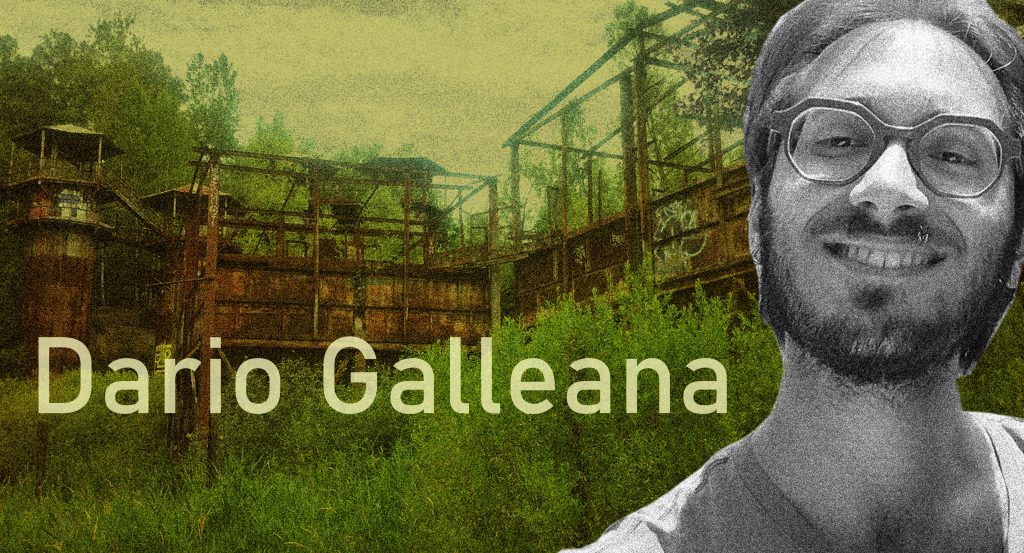
In the second episode of Footnotes, I invite you for a soundwalk with Dario Galleana, a Torino-based sociologist, researcher, ethnographer and sound practitioner who often collaborates with local communities, using sound and listening practices to bring their complex stories to the surface.
As a site for our walk I chose Liban, an old quarry in Kraków, Poland, my hometown. Recently turned into a natural reserve, the quarry is perhaps best known for having been used as a set for Schindler’s List, the Oscar-winning film by Steven Spielberg that tells the story of Oskar Schindler, a German industrialist who saved over a thousand Jewish people from the Holocaust by employing them in his factories during World War II. To this day, Liban still carries traces from that production: barbed wire from a reconstructed concentration camp—originally located only a few hundred meters from here—ceramic insulators, and fake Jewish tombstones.Yet beyond these cinematic remnants, the site holds other temporal layers—from the deep Jurassic era to the industrial mining infrastructure of the 18th century.
Our conversation touched on many aspects of listening to places with multilayered and multi-temporal nature, such as the quarry in Kraków and the nearby site of a former German Nazi concentration camp. We spoke about how listening can be porous in terms of opening one’s perception toward the other, toward history, and toward possible futures. We reflected on what it means to engage in listening as a participatory practice, and on the importance of attention to sound in community building.
Enjoy the recording from our walk, and don’t forget to check the footnotes below.Those footnotes are by no means of secondary importance. To the contrary, they are necessary elaborations, pointing to sources and foundations of some of the thoughts shared as we walked.
Footnotes
2:33 The notion of the palimpsest has been explored in sound and music studies by scholars such as Martin Daughtry. He describes how layers of past sounds—and the social meanings embedded in them—persist in acoustic environments, making listening a way to perceive overlapping histories and politics. The term “palimpsest” originally refers to an ancient writing medium, such as parchment, that has been scraped or washed clean to be reused, while traces of the original text remain visible beneath the surface. Martin Daughtry, “Acoustic Palimpsests and the Politics of Listening,” Music and Politics 7, no. 1 (Winter 2013).
3:54 The concept and practice of transversal listening has been explored by Jacek Smolicki in several projects, including his practice of Minuting, a long-term project of daily sonic journaling initiated in 2010. In his essay Minuting Rethinking the Ordinary Through the Ritual of Transversal Listening, Smolicki describes transversal listening as a reflective, constrained practice that extends beyond immediate auditory experiences. It involves attuning oneself to layers of sound that connect spatially and temporally distant events, objects, and environments, fostering a form of listening that is both situated and expansive.
This approach draws on media studies, sound studies, and philosophy of technology to propose transversal listening as an existential media technique for
composing critical and reflective positions towards one’s surrounding space, experience of time, and use of sound technologies. Read more on: Jacek Smolicki, Minuting: Rethinking the Ordinary Through the Ritual of Transversal Listening, VIS: Nordic Journal for Artistic Research, no. 5 (2021), https://www.researchcatalogue.net/view/883787/883788
5:06 Endangered Sounds is a podcast developed by Dario Galleana and the episode entitled. The Voice of Cevo is based on ‘a sensory-based action-research project that gives voice to the inhabitants of Cevo through sound installations scattered on the walls of the village.’Source: https://dadadada.it/endangered-sounds/
5:35 To learn more about Liban Quarry, read for example: Roksana Zarychta, “Krajobraz poeksploatacyjny kamieniołomu Liban w Krakowie,” Przegląd Geologiczny 67, no. 12 (December 2019): 1002–1011
5:47 Schindler’s List, directed by Steven Spielberg (Universal Pictures, 1993). The film was largely shot on location in Kraków, including in and around the former Jewish district of Kazimierz and the site of the Plaszów labor camp.
7:55 Kraków was annexed by Austria in 1846 and remained part of the Austrian, later Austro-Hungarian Empire, until the collapse of the monarchy in 1918, after the Great War.
8:48:An article on the website of Akcja Ratunkowa dla Krakowa, a community initiative established in response to the deepening climate and ecological crisis and the lack of effective action by the city authorities. The group’s work has significantly contributed to turning the former Liban Quarry into a protected natural environment.
https://akcjaratunkowadlakrakowa.pl/kamieniolom-libana/sukces-uzytek-ekologiczny-na-terenie-bylego-kamieniolomu-libana/
11:41 Theodor W. Adorno, Introduction to the Sociology of Music, trans. E. B. Ashton (New York: Seabury Press, 1976).
12:58 Porta Palazzo is often considered as the Western Europe’s largest open-airmarket,and as a central economic, social, and cultural hub for Italians and migrants in the city of Turin. Read more in Rachel E. Black, Porta Palazzo: The Anthropology of an Italian Market, foreword by Carlo Petrini, Contemporary Ethnography (Philadelphia: University of Pennsylvania Press, 2012),
16:30 Read more about the history of Plaszow Concentration Camp on Krakow Museum website: https://muzeumkrakowa.pl/en/news/history-of-german-nazi-concentration-camp-in-krakow-plaszow
17:45 Plaszow Concentration Camp and Liban Quarry are among the sites explored by Jacek Smolicki in his ongoing project Quivering Stillness, which documents contemporary soundscapes of places affected by military conflicts and environmental catastrophes.
Read more on: https://para-archives.net/quiveringstillness/002.html and Jacek Smolicki, “Eyes that Listen, Ears that See: The Para-Archive of Quivering Stillness,” Public Art Dialogue 9, no. 1 (2019): 53–64, https://doi.org/10.1080/21502552.2019.1571822
18:00 By heterotopia here, I mean a place that, within its seemingly seamless and uniform organization, comprises elements and fragments of distant places, histories, and agencies. Michel Foucault, in his text “Of Other Spaces: Utopias and Heterotopias” (Architecture /Mouvement/ Continuité, October 1984, originally presented as “Des espaces autres” [March 1967], trans. Jay Miskowiec), describes heterotopias as cultural, institutional, or discursive spaces that are incompatible with, contradictory to, or disturbing of their surrounding environments, acting as a “world within a world” that comprises conflicting histories, places, and functions.
23:40 Phillip Vannini, ed., The Routledge International Handbook of Sensory Ethnography (New York: Routledge, 2024).
33:10 Simmel, Georg, “The Metropolis and Mental Life” in Wolff, Kurt (ed.), The Sociology of Georg Simmel, New York: Free Press, 1950, p. 409.
47:10 The mentioned project, entitled Dzielnica (‘the quarter’ in English), is a memorial soundwalk through the former Jewish Ghetto in Kraków, developed to commemorate the 70th anniversary of its liquidation. Read more on: https://www.smolicki.com/dzielnica.html
48:45 Psychohistory was a concept introduced by writer Isaac Asimov in his book Foundation and Empire (1952). It is a fictional science that applies mathematical and statistical methods to predict the behavior of large populations.
54:30 Solnit, Rebecca. A Field Guide to Getting Lost. New York: Viking, 2005.