

Episode 1. Soundscape Architecture with Usue Ruiz Arana
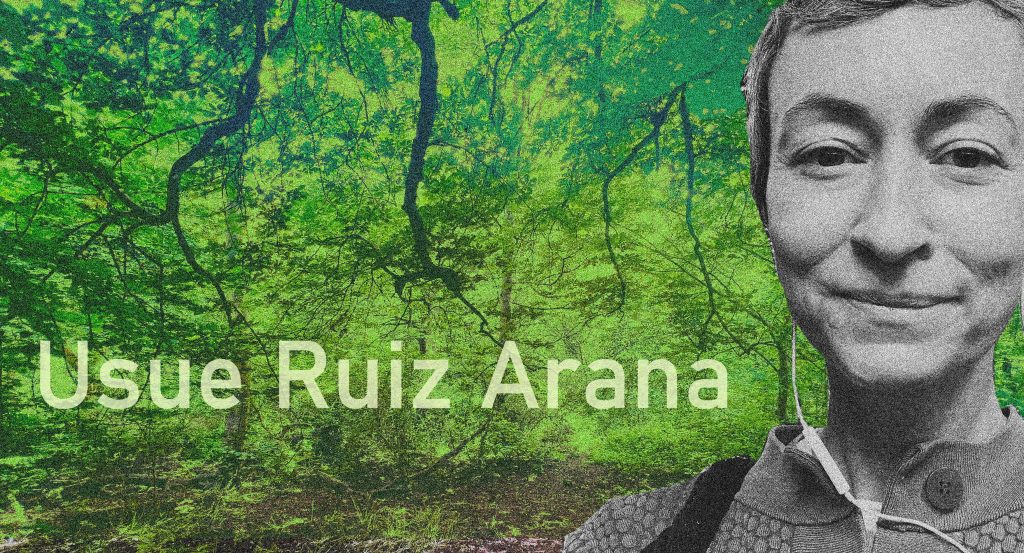
For the first episode of Footnotes, I invited Usue Ruiz Arana—an award-winning landscape architect and senior lecturer at Newcastle University, where she teaches across design studios, professional practice, and design thesis modules.
Usue’s research and scholarship advance landscape architecture as a discipline uniquely positioned to respond to planetary health, biodiversity and climate crises, and questions of social and ecological justice. Her work spans the intersecting fields of acoustic ecology, multispecies collaboration, and research by design. Through her publications and creative outputs, she is establishing a strong international presence in these emerging areas.
Our conversation touches on many aspects of her practice and research; all deeply rooted in a recognition of the importance of sound in designing our shared environments. You’ll hear how listening can meaningfully inform landscape architecture and shape more responsive, inclusive, and sustainable public spaces. You’ll also discover why—and how—we should include more-than-human actors and their voices in the planning and creation of our lived environments. I met Usue in early summer this year and we walked in two different environments, connected via mobile phones. Enjoy the record of this walk. And check out the footnotes below that list and elaborate on references mentioned during the walk.
Footnotes:
02:59 The term peripatetikos (Greek: περιπατητικός) refers to the practice of walking while teaching or philosophizing, and is commonly associated with Aristotle and his followers, who conducted discussions while walking the colonnades of the Lyceum.
03:00 Coined in the 1950s by Guy Debord, a French philosopher and member of Situationist International, the term psychogeography refers to the emotional and psychological effects of urban environments on individuals that are invoked through drifting or walking practices that reveal hidden patterns and atmospheres within the cityscape.
03:01 The practice of flânerie and the figure of the flâneur, popularized by Charles Baudelaire and later theorized by Walter Benjamin, denotes a modern urban walker and observer—both a participant in and a critic of the spectacle of urban life..
03:40 Solnit, Rebecca., 2000. Wanderlust: A History of Walking. New York: Viking.
07:15 Usue Ruiz Arana’s profile on Newcastle University website https://www.ncl.ac.uk/apl/people/profile/usueruiz-arana.html
08:15 Ruiz Arana, Usue. 2024. Urban Soundscapes A Guide to Listening for Landscape Architecture and Urban Design, Abingdon, UK: Routledge
10:05 Jesmond Dene is a historic park in Newcastle upon Tyne, established in the 19th century and donated by Lord Armstrong in 1883. It follows the wooded valley of the River Ouseburn and features native and exotic trees, walking paths, waterfalls, and historic sites including a ruined mill and chapel. The park also includes a small animal area called Pets’ Corner and the Armstrong Bridge. Read more on: https://jesmonddene.org.uk/
11:20 Sticklinge Nature Reserve, established in 2023 on the island of Lidingö near Stockholm, is a diverse natural area combining old oak and coniferous forests, coastal meadows, and ancient burial sites. Covering over 100 hectares, it offers rich biodiversity and scenic trails. As one of Lidingö’s largest protected areas, it provides space for recreation and reflection while preserving important ecological and cultural heritage.Read more on https://www.naturkartan.se/en/stockholms-lan/sticklinge-naturreservat
12:18 Coined by R. Murray Schafer in the 1970s, the term schizophonia refers to the disconnection between what is heard and its original context, a concept central to acoustic ecology and soundscape studies.
13:55 Deep listening is a practice developed by composer Pauline Oliveros that involves heightened awareness and engagement with sound. Deep listening blends aspects of meditation, improvisation, and sonic awareness, aiming to cultivate empathy, presence, and a deeper connection to the world through sound. Read more on the Center for Deep Listening’s website: https://www.deeplistening.rpi.edu/deep-listening/
13:56 Mathews, Freya. 2009. Invitation to Ontopoetics, PAN: Philosophy Activism Nature 6
19:30 Ruiz Arana, Usue. 2024. Urban Soundscapes A Guide to Listening for Landscape Architecture and Urban Design, Abingdon, UK: Routledge
21:03 The Old Pottery is a former family-owned fireclay pottery on the outskirts of Corbridge, UK. Read more on:
22:48 Newcastle University profile of Mark Whittingham, Professor of Applied Ecology https://www.ncl.ac.uk/nes/people/profile/markwhittingham.html
25:05 Molendinar Burn is a small river or burn which runs through Glasgow, Scotland. It is a tributary of the River Clyde, one of Scotland’s major rivers.
27:20 Henna Asikainen, Roua Horanieh, and Usue Ruiz Arana’s work has been presented at Refugee Week at The Baltic Center for the Arts. You can read more about it here: https://refugeeweek.org.uk/refugee-week-public-art-comissions-for-moomin-80/
34:48 The ISO 12913 series on soundscape was developed in order to enable a broad international consensus and to provide a foundation for communication across disciplines and professions with an interest in soundscape. You can read more about it here: https://www.iso.org/obp/ui/#iso:std:iso:ts:12913:-3:ed-1:v1:en
37:12 The ancient burial ground at Tyktorpsvägen is located on Lidingö, at the edge of Sticklinge Reservat, and contains at least 40 graves from the Iron Age, dated to the period 500 BCE – 1050 CE. The area is fenced off and used as grazing land for sheep. Source: https://www.naturkartan.se/en/
41:28 See, for example, Wismayer, Henry., 2023. Finding awe amid everyday splendor: A new field of psychology has begun to quantify an age-old intuition: Feeling awe is good for us. Noema, [online] 5 January, https://www.noemamag.com/finding-awe-amid-everday-splendor/, Smolicki, Jacek. 2023, Between Sferics and Rust. On the Erratic State of Being Grounded and Dissolved through Listening. Bioart Society (blog), 5 September. Available at: https://bioartsociety.fi/posts/between-sferics-and-rust-on-the-erratic-state-of-being-grounded-and-dissolved-through-listening
46:12 Vinciane Despret is a Belgian philosopher of science and author of What Would Animals Say If We Asked the Right Questions? published by Minneapolis: University of Minnesota Press in 2012.
48:12 D.I.R.T. studio (Dump It Right There) was founded in 1992 by Julie Bargmann as a critical, design research-based practice driven by a love for the landscape. Read more here: https://www.dirtstudio.com/index.html
50:33 Field recording of ants foraging near their nest in Sticklinge Reserve