

Episode 3. intimate immensity with Mary Edwards
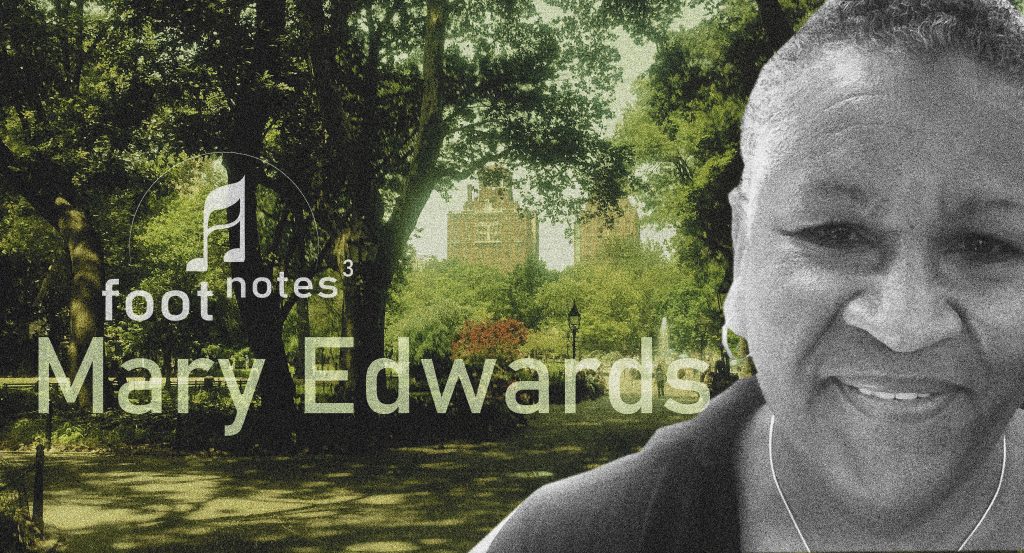
In this episode, I invite you on a soundwalk with Mary Edwards, a New York–based composer, sound artist, field recordist, and writer whose work explores the vibratory, emotive, historical, and spatial properties of sound—often at the intersection of the natural world and built environments. For Mary, listening is an inherent and integral part of the artistic process, and she approaches all sounds as having the potential to be both habitable and transformative.
As we walk together through the quieter and noisier soundscapes of New York’s Washington Square, the place becomes a gateway for Mary to speak about her family and about shifting political and power relations that shape not only how places sound—or sounded—but also for whom they sound, and for whom they have been inaccessible: both as arenas of participation and as spaces of simple witnessing.
Referring to her work in the Arctic Circle, Everywhere We Are is the Farthest Place, we reflect on how even the most distant environments carry traces of the places we inhabit every day. We consider how capturing and sharing the experience of distant places is not about pursuing the “most authentic” or “most representative,” but about using one’s imagination to spark the imagination of others.
Join me for a walk with Mary and don’t forget to check out the footnotes that reference the topics we discussed and which you will find right below.
Footnotes:
1:07 One of the first appearances of the term soundmark is in the Handbook for Acoustic Ecology, edited by Barry Truax and first published in 1978. The term derived from “landmark,” used in soundscape studies to refer to a community sound that is unique or possesses qualities that make it especially regarded or noticed by the people in that community. Soundmarks, therefore, are of cultural and historical significance and merit preservation and protection.
Source: https://www.sfu.ca/sonic-studio-webdav/handbook/Soundmark.html
2:46 The Ramble in Central Park is the most well-known of the park’s three woodland landscapes, offering visitors an experience of the woods in the heart of New York City. https://www.centralparknyc.org/locations/the-ramble
4:15 For more information about Mary Edwards’ projects and research, visit her website: https://www.maryedwardsmusic.com/
7:52 More information about the Washington Square Arch can be found here: https://www.nycgovparks.org/parks/washington-square-park/monuments/1657
For a critical study of history and symbolism of architectural arches, especially in the light of the currently debated project of an arch
commemorating the 250th anniversary of the USA put forth by Donald Trump, see the article by Sarah E. Bond at https://hyperallergic.com/1050375/the-arch-of-trump-triumph-and-downfall/
11:58 Official website of The Roches, an American vocal trio of sisters Maggie, Terre, and Suzzy Roche from Park Ridge, New Jersey, active between 1973 and 2017:
http://roches.com/
13:55 Gaston Bachelard (1884–1962) was a French philosopher known for his work on poetics, imagination, and the philosophy of science.
In The Poetics of Space, he explores how intimate spaces—such as houses, rooms, and corners—shape our imagination and sense of being in the world.
(Bachelard, Gaston. The Poetics of Space. Boston: Beacon Press, 1994.)
19:30 John Luther Adams is an American composer whose music is deeply inspired by nature and environmental awareness. He often translates landscapes and ecological processes into immersive sonic experiences. His works blur the boundaries between music, place, and listening.
https://johnlutheradams.net/
30:55 Mary Edwards’ composition The Wa(l)king Pattern “is comprised of rhythmic and tonal inflections along the stretch of Holland Road in Register, Georgia,
in perpetuity to Edwards’s mother, Jewel Edwards, and her resolute 4 a.m. daily walk to school, as she navigated fox trails—and the Jim Crow laws of the 1930s segregated American South—cultivating an ecological stewardship through the guidance of devotional humming of disembodied voices.” https://maryedwardsmusic.bandcamp.com/track/the-wa-l-king-pattern-the-wa-l-king-pattern-revisited
32:20 Wa Na Wari creates space for Black ownership, possibility, & belonging through art, historic preservation, & connection, https://www.wanawari.org/
38:10 Situated midway between mainland Norway and the North Pole, Svalbard is one of the fastest-warming places on Earth. Temperatures there are rising several times faster than the global average, leading to rapid melting of glaciers, thawing of permafrost, and profound changes to its fragile ecosystems.
47:25 Matthew Henson was an African American explorer who, alongside Robert Peary, became one of the first people to reach the North Pole in 1909.
48:20 Mae Jemison is an American engineer, physician, and NASA astronaut who became the first African American woman to travel into space aboard the Space Shuttle Endeavour in 1992.
48:56 Ronald McNair was an American physicist and NASA astronaut who tragically died in the Challenger explosion on January 28, 1986. The shuttle broke apart shortly after liftoff, killing all seven crew members. McNair was the second African American to go to space.
49:26 Trayvon Martin was a 17-year-old African American student who was fatally shot by neighborhood watch volunteer George Zimmerman in Sanford, Florida, on February 26, 2012. The incident and Zimmerman’s later acquittal sparked nationwide protests and debates about racial profiling, justice, and civil rights in the United States. https://www.britannica.com/event/shooting-of-Trayvon-Martin
1:06:50 Lisa Goren is a watercolor painter whose work frequently explores polar and frozen landscapes, and more recently animal imagery and other thematic series https://www.lisagorenpaintings.com/